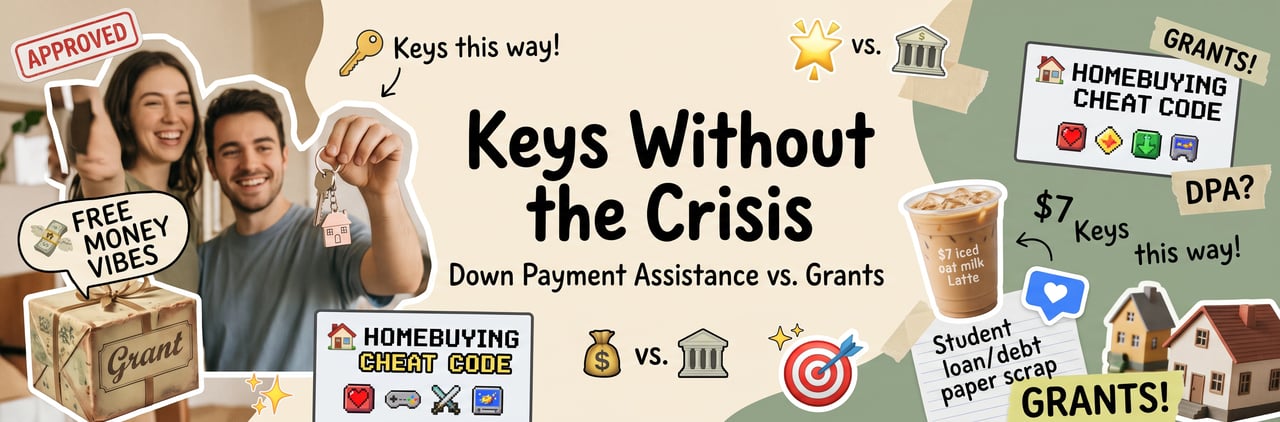
Keys Without the Crisis: Down Payment Assistance vs. Grants (A Millennial’s Guide) 🏡✨
If you’ve spent any time scrolling Zillow like it’s a dating app 📱, you’ve probably hit the ultimate millennial boss battle: the down payment. Between paying off student loans 🎓, surviving grocery store inflation 🛒, and resisting the urge to buy a $7 iced oat milk latte 🧋, saving up tens of thousands of dollars in cash can feel like an extreme sport.
Enter the homebuying cheat codes: Down Payment Assistance (DPA) and Grant Programs 🕹️💰.
People toss these two terms around like they’re interchangeable, kind of like "affect" and "effect." Spoiler alert: they aren't the same thing. Knowing the difference could literally save you thousands of dollars—and keep you from getting blindsided by fine print later 🔍.
Grab your favorite beverage and let’s break down the ultimate showdown: DPA vs. Grants 🥊.
First, the Plot Twist: Grants Are a Type of DPA 🤯
Before we pit them against each other, let’s clear up the biggest misconception in real estate. Down Payment Assistance (DPA) is the big umbrella term ☂️ for any program that helps you cover your upfront homebuying costs (your down payment and, often, closing costs).
Grants are one specific—and wildly popular—flavor of DPA 🍦.
When people compare "DPA vs. Grants," what they’re really comparing is repayable/forgivable assistance loans versus true, no-strings-attached grants.
Round 1: True Grant Programs (The "Free Money" Vibe) 💸🎉
If DPA programs were celebrities, grants would be Keanu Reeves—universally loved and genuinely helpful 🌟.
A homebuyer grant is gift money 🎁 from a state housing finance agency, local government, nonprofit, or even a big bank. You use it toward your down payment or closing costs, and you never have to pay it back. Not next month, not in five years, and not when you eventually sell the house.
The Pros ✅: Zero repayment. It instantly boosts your equity on day one without adding a second monthly bill to your plate. Plus, keeping your own cash in your high-yield savings account means you actually have an emergency fund when the water heater inevitably breaks three weeks after move-in 🔧💦.
The Catch ⚠️: Because it’s free money, it goes fast 🏃💨. Grant funds are limited and often run out before the end of the year. They also tend to have stricter income caps, require you to use specific approved lenders, and sometimes come with a slightly higher interest rate on your main mortgage to offset the free cash. (Bonus tip: Some bank grants can be considered taxable income, so keep an eye out for a 1099 form at tax time! 🧾)
Round 2: Other DPA Programs (The "Low-Key Loans") 🤝🏦
Since true grants make up less than 10% of all assistance programs nationwide, most of the DPA options you’ll run into are actually structured as second mortgages. Before you panic 😱—no, these usually aren't scary, high-interest loans. They typically fall into three chill categories:
Forgivable Loans 🪄: Think of these as "grants in disguise." You get a second loan for your down payment, and as long as you live in the home as your primary residence for a set period (usually 5 to 15 years), the loan is 100% forgiven. Move or refinance early, though, and you'll have to pay back some or all of it.
Deferred-Payment Loans ("Silent Seconds") 🤫: You get the cash upfront with 0% interest and no monthly payments. The catch? The balance sits quietly in the background until you sell the house, refinance, or pay off your main mortgage—at which point you pay it back out of your home's proceeds.
Low-Interest Repayable Loans 📉: A straightforward second loan with a small monthly payment and a low interest rate, paid alongside your regular mortgage.
The Pros ✅: Way more funding is available, the dollar amounts are often larger than grants 💰, and income limits can be much more generous (plenty of programs allow household incomes well over $100,000!).
The Catch ⚠️: Unless it’s fully forgiven, it’s still debt. If you plan on using this house as a starter home and selling in three years, a deferred loan will eat into your profit when you cash out.
The Vibe Check: Side-by-Side Comparison 📊👀
Feature | True Grant Programs 🎁 | Loan-Based DPA (Forgivable / Deferred) 🏦 |
Do you pay it back? | Nope! Free and clear 🎉 | Maybe. Forgiven after set years, or repaid when you sell/refinance ⏳ |
Availability | Competitive; funds can run dry 🏜️ | Much more common (makes up the majority of programs) 📈 |
Best for... | Short-term stays or buyers who hate the idea of a second lien ✌️ | Buyers planting roots for 5+ years who want bigger assistance amounts 🌱 |
Income Limits | Usually stricter (often tied to Area Median Income) 📋 | Often higher and more flexible 🙌 |
Wait—Do You Even Qualify? (Spoiler: Probably!) 🎯
A lot of millennials count themselves out before they even apply. Here are three myths you can officially retire 🗑️:
"I’m not a first-time buyer because I owned a condo in my 20s." In the mortgage world, "first-time homebuyer" just means you haven't owned a principal residence in the last three years. Your status resets! 🔄
"I make too much money." Assistance isn't just for low-income buyers anymore. Over 60% of assistance programs allow incomes above $100,000, and some have no income caps at all depending on where you buy 💵.
"It's going to delay my closing." As long as you work with a lender who is already certified with your state's Housing Finance Agency (HFA) and knock out the required online homebuyer education course early 💻, it barely adds a beat to your timeline ⏱️.
Your Next Move 🚀
You don’t need a trust fund to become a homeowner—you just need the right strategy 🧠. Start by Googling "[Your State] Housing Finance Agency" or asking a local lender which grant and DPA programs you can stack together. Your future front porch is waiting 🌻—and you don't even have to give up your iced lattes to get there 🧋✨.